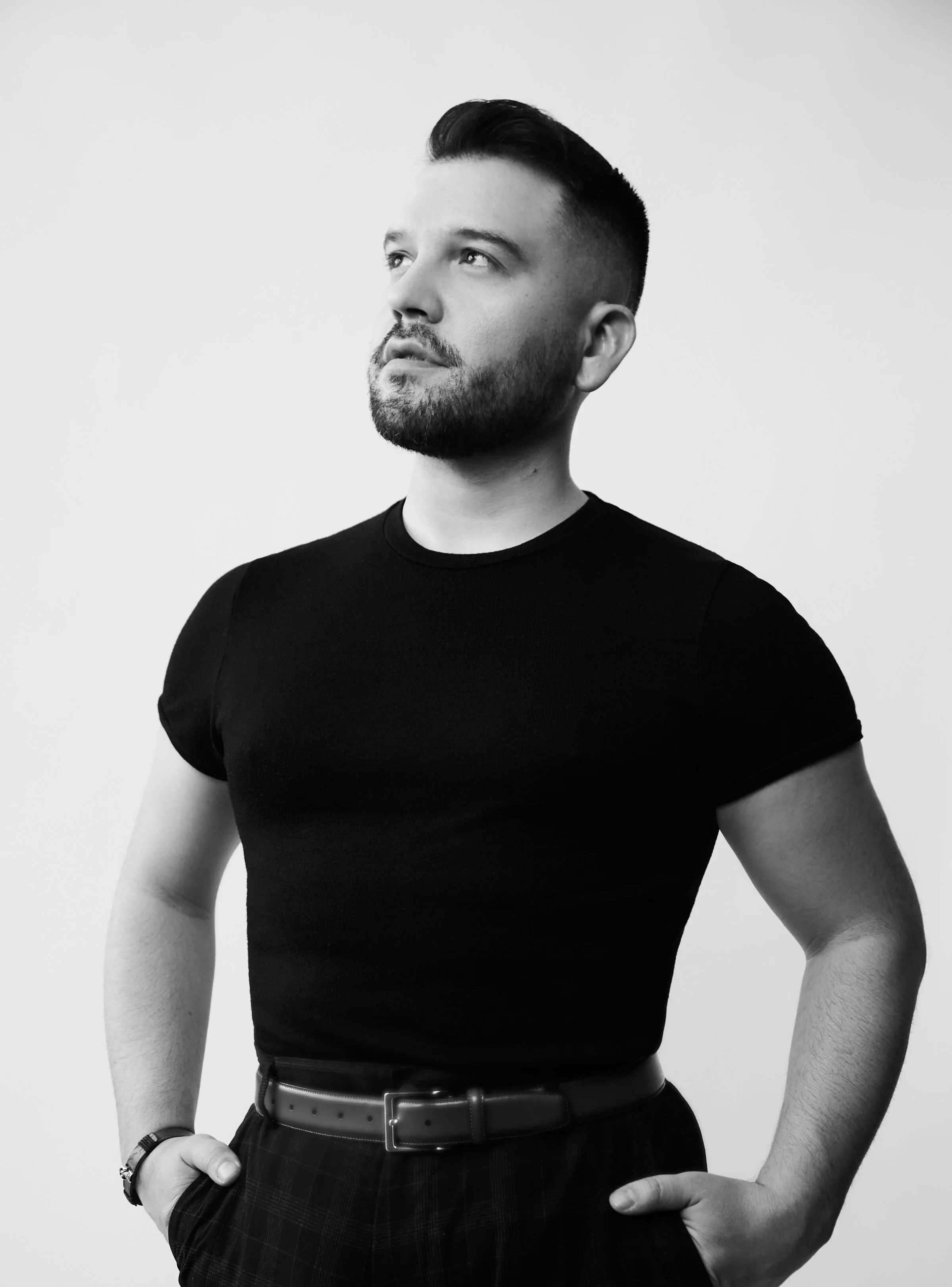
photo by Whitney Browne
I am a Bolivian-Welsh Tejano artist based in New York. I grew up in a multicultural, multilingual home in Chicago, where my parents instilled in me a deep love of music, reading, and fine art. I studied the Impressionists, read texts by Greek authors, practiced piano concertos, and trained in Balanchine ballet. These forms became part of my artistic lineage. Today, as a theater artist, I want to claim my place inside them.
I’m interested in using heightened, classical forms to tell contemporary stories about Latinos. I direct and choreograph revivals of classic works with Latinos in leading roles, and I create new plays and musicals about Latinos who are artists, scientists, politicians, executives, and global superstars. These characters fall madly in love, feel lost, make terrible mistakes, reckon with estranged families, get their hearts broken, and wonder what any of this is for. I want to make room for the wild, romantic, intellectual, ridiculous, devastating breadth of Latino life, far beyond the stories American culture has historically expected us to tell.
I want to make Latinos the subjects of legendary works of art like the ceiling of the Sistine Chapel… “A Sunday on La Grande Jatte…” Swan Lake, Richard III, Giselle, and Oedipus. I want to see us playing the cello, wearing pointe shoes, sculpting marble... I want to portray Latino minds and bodies as beautiful, world-class works of art themselves, and Latinos as impeccable, world-class artists.
There are political implications to this work, particularly at a moment when Latine communities in the United States are facing systemic removal at the hands of the federal government. But my relationship to these forms is older and more personal than this political moment. I make this work because I am a mixed-race Latino who grew up loving these traditions. They shaped my understanding of beauty, storytelling, music, and movement, and they shaped my understanding of myself. I do not see a contradiction between my cultural identity and my classical artistic inheritance.
Theatre scholar Amy Cook’s research gives language to something I’ve always felt instinctively: when we put a body in a role an audience has not been conditioned to associate with that body, we expand their understanding of who can embody power, authority, heroism, romance, and legitimacy. When an audience sees a Latino actor as a king, their understanding of what a king can look like gets a little bigger.
That possibility thrills me. I want to make work in which Latino lives are not exceptional for occupying these spaces. I want us to be part of the artistic and cultural canon, as kings and lovers, heroes and fools, ballerinas and musicians, subjects and makers of great art. I want to expand what, and whom, we understand as classical, beautiful, and worthy of being preserved.